
The Carbon Dioxide Removal implications of the new CMIP7 future emission scenarios
Out with RCP and SSP, the modelling community has published the new scenario set for the next IPCC reporting round. They throw CDR & SRM requirements into sharp focus for meeting the Paris goals.

The climate and Earth system modelling work for IPCC and other reports leans on sets of pathways or scenarios that describe potential climate policy directions. The first set was developed between 2009-2011 and was used for the modelling work in CMIP5. The fifth round of the Coupled Model Intercomparison Project (CMIP). It was called Representative Concentration Pathways (RCPs) and focused strictly on the outcomes of human activity—specifically, atmospheric greenhouse gas concentrations and the resulting radiative forcing (measured in Watts per square meter, W/m2) by the year 2100.
The main pathways were RCP2.6 (low warming), RCP4.5 and RCP6.0 (intermediate warming), and RCP8.5 (high warming/expanding fossil fuel use). RCPs provided the climate models with target physical numbers, but they didn’t explain how society would get there. There were no integrated political, economic, or demographic narratives attached to them.
The next iteration was the development of the Shared Socioeconomic Pathways (SSPs) between 2015 and 2021. These are the pathways currently in use by CMIP6. These introduced five distinct global socioeconomic narratives detailing how population, education, technology, and geopolitics might evolve over the century.
The Core Narratives were:
SSP1: Sustainability (”The Green Road”)
SSP2: Middle of the Road
SSP3: Regional Rivalry (”A Rocky Road”)
SSP4: Inequality (”A Divided Road”)
SSP5: Fossil-fuelled Development
Climate scientists combined these five human storylines with the physical forcing outcomes of the RCPs. For example, SSP5-8.5 represents a world of rapid, fossil-fuelled economic growth resulting in the extreme 8.5W/m2 forcing. This SSP framework powered the IPCC’s Sixth Assessment Report (AR6), completed in 2023.
A new set is being developed for CMIP71 which will be used for the next IPCC report (AR7) to be published around 2028-2029. Headlines have focussed on the removal of the old, very high end SSP5-8.5, which is increasingly viewed as implausible given the global rollout of renewable energy and increasing fossil fuel extraction costs. Deniers have pounced on this news, claiming that earlier climate predictions have been over-hyped, which is just not true, but when has that ever stopped them
Instead of just telling climate models what the greenhouse gas concentrations will be, CMIP7 will run more scenarios in an “emission-driven” mode. This allows the models to calculate their own carbon cycle feedbacks, providing a more accurate picture of climate uncertainty. It also allows feedbacks such as permafrost melt to add to the emissions within the models rather than be somehow included in the budgets.
The high end scenario, conveniently named “High”, shows continued emission growth to the end of the century, effectively replacing SSP5-8.5 but at a more realistic level of emissions growth set against current reality. It represents a scenario where current climate policy is rolled-back and fossil fuel burning and deforestation continues to grow.
The goal of the modelling work to come is then to calculate the Earth’s response to these emission trajectories, while reflecting current geopolitical realities, updated economic data, and the landscape of international climate agreements. As such some of the scenarios indicate emission pathways that allow the Paris 2ºC goal to be met. Interestingly none of them constrain temperatures below the 1.5ºC target since that is now basically impossible (without solar radiation modification). The new “Low-Negative” scenario could achieve a return to below 1.5ºC but later in the 22nd century.
The new scenarios
Seven emission scenarios are proposed. These can be divided into baseline scenarios and mitigation scenarios. High and Medium are based on continued emissions consistent with rolling back current policies (High) and a steady state pathway consistent with policies frozen as of 2025 (Medium). These are the baseline scenarios. Both result in more than 3ºC of warming by 2100, continuing to increase thereafter. A new High-to-Low scenario follows the High emissions pathway until after mid-century then a rapid decline to net-zero by the middle of the next century. It tracks a world that reaches 3ºC, then either suffers economic collapse (as suggested by the Institute and Faculty of Actuaries for a 3ºC world2), or humanity makes a collective decision that enough is enough and rapidly cuts emissions voluntarily.
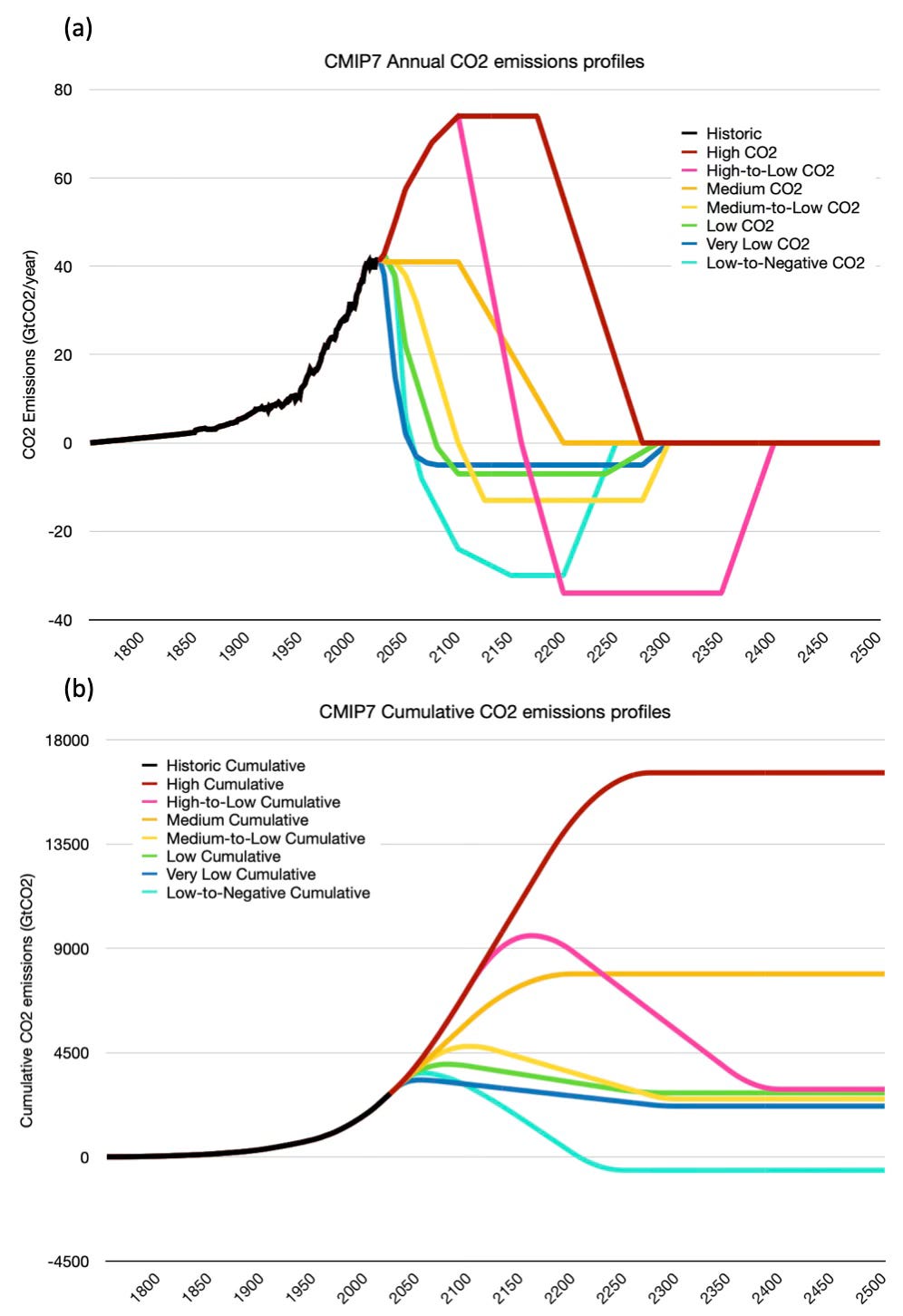
The remaining four scenarios all have varying degrees of ambitious decarbonisation and emissions reduction, striving to meet the Paris goals. These are the mitigation scenarios. Medium-to-Low follows the Medium pathway to 2050 then strives for net-zero CO₂ by 2100. Low strives for 2ºC by 2100 with net-zero GHG (not just CO₂). Very Low strives for 1.5ºC by 2100 with rapid emissions decline and a low overshoot. Finally Low-to-Negative follows the Low scenario but uses more negative emissions to hit 1.5ºC by 2100 but with a higher overshoot than the Very Low scenario.
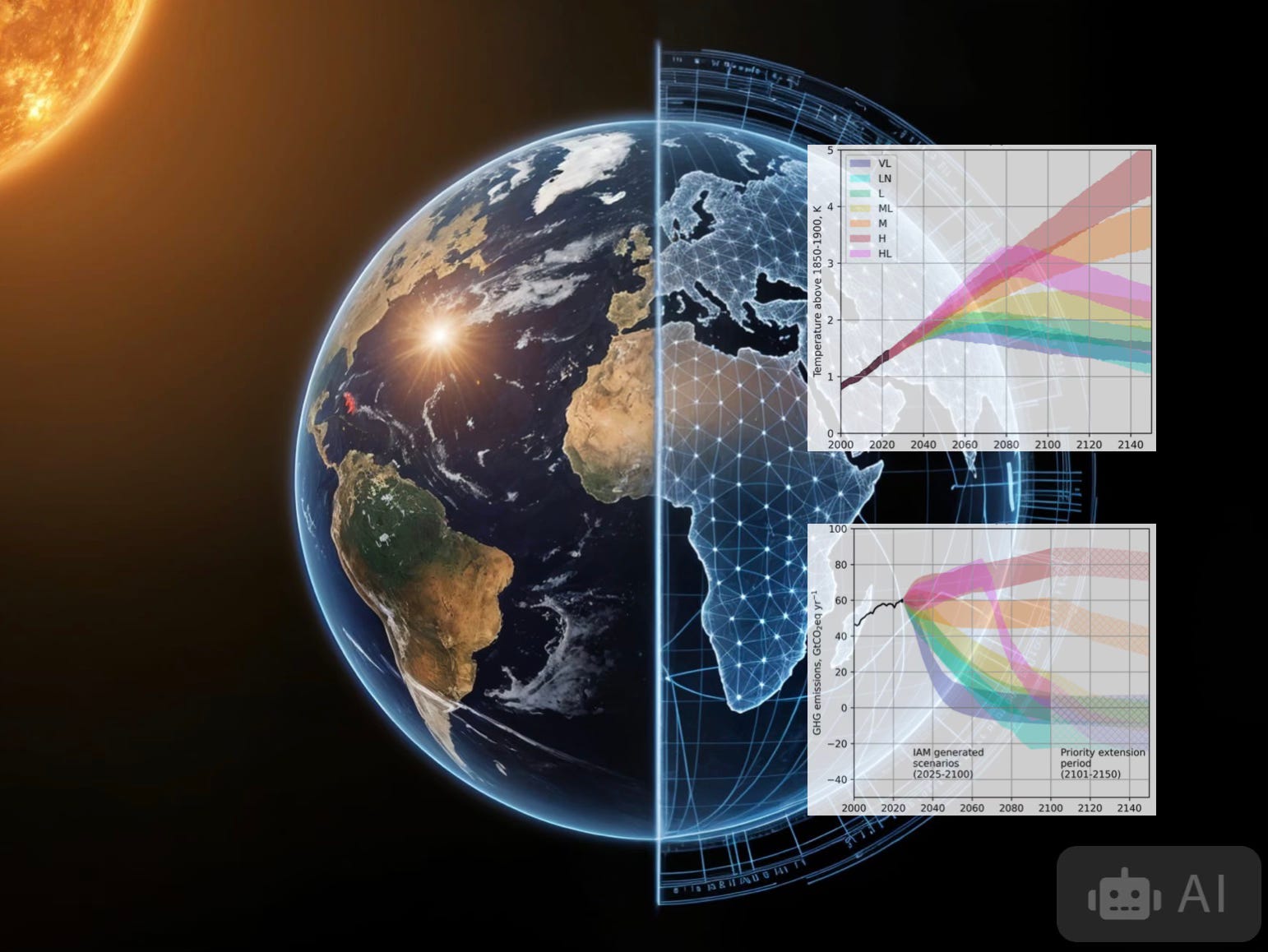
The keen eyed may have noticed that figure 1 is slightly different from the graphs provided in the Van Vuuren paper, included in the header image. This is due to the paper’s figures being illustrations rather than taken from the latest CMIP7 data files, which were still under development when the paper was submitted.
Where are we now?
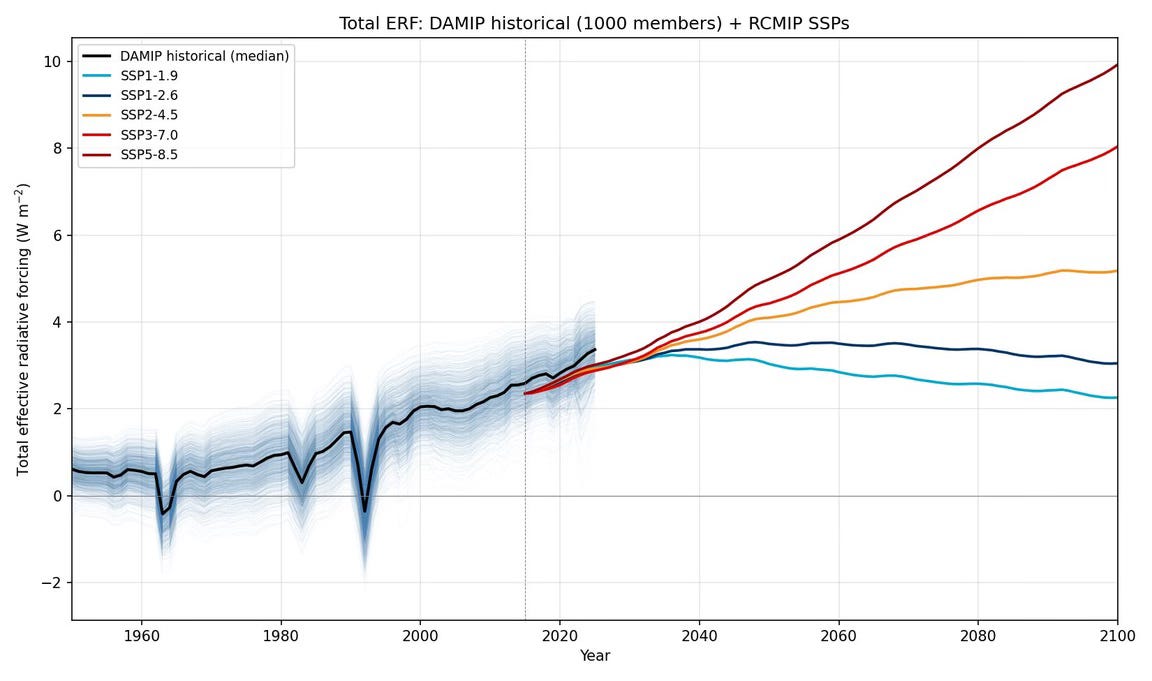
All scenarios start at the measured 2025 point in terms of emissions. Incidentally this is another reason for dropping SSP5-8.5. Since its formulation in 2015, emissions have not grown to the extent suggested in the 10 years since then. Temperature have done, as has the radiative forcing which is actually higher than all the SSPs including SSP5-8.5, but that’s for the models using the emissions scenarios to sort out.
Predicting the future is obviously very difficult but it’s probably a fairly safe bet to go along with the IEA 2025 report for Energy related CO₂ emission which suggest very little change out to 2050. This would suggest the Medium scenario is the most likely in the short term. Given current geopolitics and the tightening grip of the fossil fuel lobby supporting right-wing politics in many countries, the chances of a short term switch to Medium-to-Low or Low are slim. The chances of following Very Low or even Low-to-Negative are negligible in the short term.
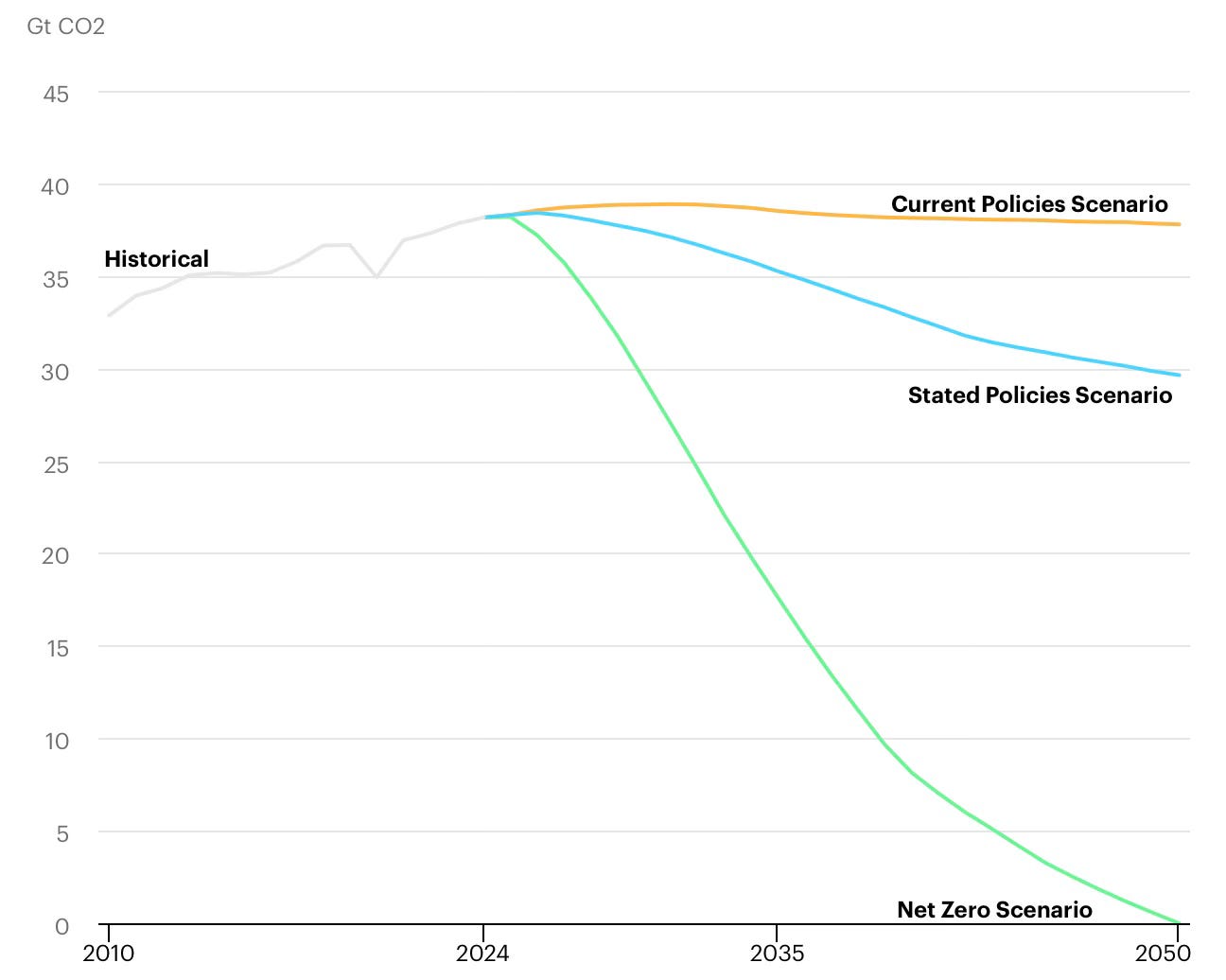
However, the world continues to change, even in the short time since the IEA analysis and the CMIP7 scenarios were developed. The US-Israeli war on Iran and the subsequent blockades of the Straight of Hormuz will have an impact. According to the IEA May 2026 Oil Market Report3, cumulative oil losses to date exceed 1 billion barrels. 14.4 million barrels a day is shut in. An increase in production in other areas is providing 3.5mb/d with the shortfall coming from stocks and reserves. That rate of reserve extraction is unsustainable though. Price increases and supply problems will soon start to destroy demand, leading to the IEA now forecasting a drop in annual demand in 2026 compared to 2025. Long term, the resultant and inevitable economic recession is likely to push emissions down, possibly to 2005 levels for a decade (similar to the effect of the 1970s oil crises). Many countries are seeing the added security and reliability benefits of switching to renewables too. We could therefore see the blue stated policy scenario in figure 2 play out, without the need for the policies themselves.
Against this is a rise in coal use as gas becomes more expensive and also the continuing rise in AI datacenter expansion, which is increasingly relying on gas for energy generation, both as a stopgap while grid connections are established, and as a long term plan.
On balance, given current circumstances, in my humble opinion, we will be lucky to stick to the Medium scenario with no further increase of annual emissions, but unlikely to follow the High scenario, at least until 2040.
It’s important to note however, that these are just the human emissions. As temperatures rise, natural emissions from permafrost melt and wildfire continue to rise. These will have to be added to the new scenarios within the climate models as feedbacks.
Carbon Dioxide Removal
Current trajectory puts us clearly on the path to a 3ºC world, not just by the end of the century, but by keeping emissions high, the current rate of warming will persist at best, and continue to accelerate at worst. 3ºC by 2060 with 2ºC passed in the 2030s is likely, unless things change radically.4
This brings us neatly to the mitigation scenarios for CMIP7. To follow any of these, varying levels of negative emissions are required. That means to achieve them, humanity needs to develop, scale and deploy Carbon Dioxide Removal. But how much?
Figure 3 shows the negative emissions area on the annual CO₂ emissions scenario graph. It’s substantial to say the least. Even the Very Low scenario passes net-zero by 2055 but then relies on negative emissions ramping to 5Gt a year from 2070 through 2300 - over 200 years, totalling 1,125Gt!
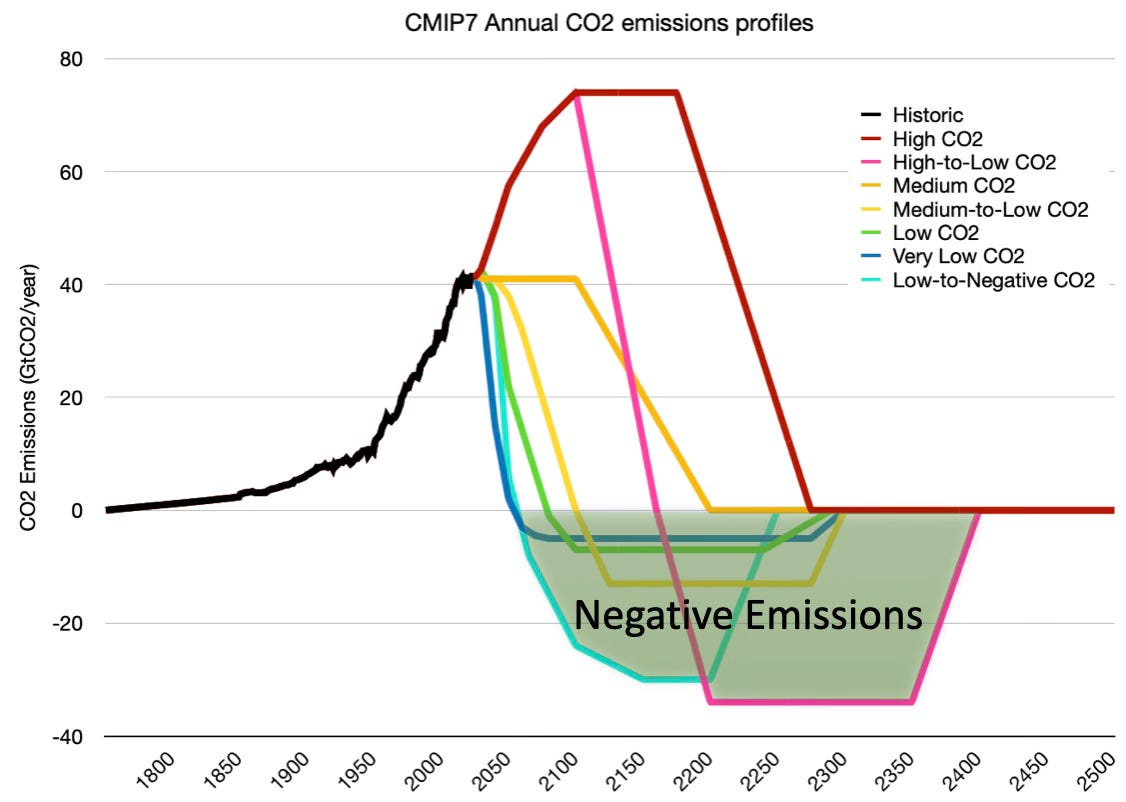
Medium-to-Low, our most likely best chance, requires net-zero by 2100 then ramping to 13Gt/year of removal from 2125 onwards. A total of 5,400Gt.
That is just part of the story though, since in order to get from where we are today with our likely short term emissions locked in, to follow any of these mitigation pathways, CDR will be required to achieve net-zero in the first place.
For example, If we assume we are going to follow the Medium path, plateaued emissions for 25 years then declining to net-zero by 2200, the resulting 4ºC+ warming will be catastrophic. To switch to a different scenarios will require CDR to correct the course down to either the Medium-to-Low, Low, or Low-to-Negative paths. We can simply subtract the path’s emissions data to show the level of CDR that would take.
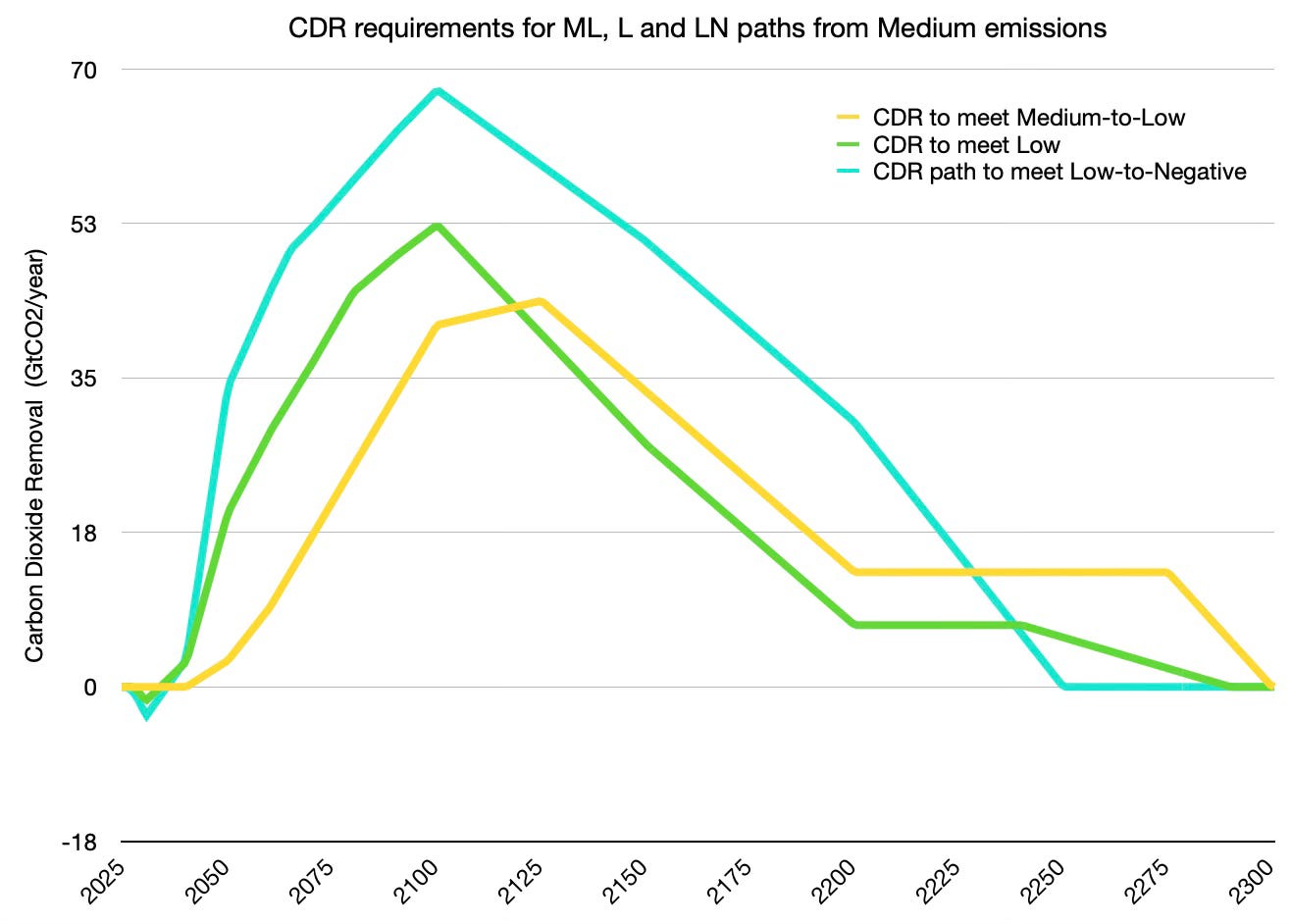
Figure 4 shows the CDR required to run alongside a Medium emissions scenario but follow the safer trajectories. None of these are going to be easy, but with little hope of survival if we don’t try, what are the options? Even so peaking at over 60Gt a year of CDR does seem a little, um, ambitious???
Proposed methods
The CMIP7 emissions scenarios do not directly account for how the CDR will be implemented, that’s not its role. It is for the following Integrated Assessment Models (IAM) to implement within their Earth System Model runs. The paper does however cover the main forms that are anticipated to be applied.
“Currently, a broad range of CDR methods is being discussed within the policy communities and considered as part of climate action plans. IAMs only represent a subset of these approaches to date however. The main CDR methods represented in IAMs are Bioenergy with Carbon Capture and Storage (BECCS), Direct Air Capture with Carbon Storage (DACCS), and afforestation and reforestation. In addition, IAMs are exploring new CDR methods such as biochar, soil carbon sequestration, enhanced weathering, storage in long-lived materials, agroforestry, improved forest management, and ocean-based CDR, although only a subset of those are included in most scenarios.”
Models will then have to experiment with different methods, locations, scales and feedbacks within the carbon cycle to generate the planet’s response, suggesting scenarios that can inform policy makers.
how the global economy pays for this level of CDR is another question entirely…
Climate Stabilisation and Solar Radiation Modification
The scenarios also show the increasing need for some form of climate stabilisation strategy involving solar radiation management or other forms of geoengineering. If we can’t develop, scale and deploy CDR within the next decade, this will be the only and last chance to avoid 3ºC. It may even be the only chance, given that CDR will take a very long time to have any impact on temperatures, given the long lag times between reduced atmospheric CO₂ concentrations and a slowing of the warming.
Until net-zero is achieved, temperatures will continue to rise, so emissions reduction and CDR to gradually reduce net emissions will only slow the rate of warming, not stabilise temperatures. Meanwhile tipping point risks increase and sea levels continue to rise. The planet also does not care where the emissions come from, so net-zero means all the natural, heat induced emissions too, not just our direct emissions. By mid century, permafrost emissions could rival those of the US, so this is not a trivial addition.
Just as Democracy is the worst form of government apart from all the others, solar geoengineering is the worst thing we can do apart from not doing it and entering a 3ºC world. It’s a conversation we need to have.
Final Thoughts
Some areas of the media and notable deniers have pounced on this paper as a way of saying that the highly warming SSP5-8.5 being dropped shows that the whole climate crisis was overexagerated. This is completely WRONG WRONG WRONG, it shows that efforts to date to slow fossil fuel burning have worked to the extent where our worst case Drill Baby Drill future has been avoided. We are still in deep trouble, but it could have been worse. Having said that the temperature acceleration and rise in Earth’s Energy Imbalance have met and exceeded SSP5-8.5, despite us roughly following SSP2-4.5 for a decade. It could have been a lot lot worse. Figure 5 posted by Prof Ryan Katz-Rosene shows the total effective radiative forcing exceeding all the SSP scenarios.
To me, the new scenarios are, if anything, even more worrying than the old ones however. They show that we have passed the point of ‘easy’ return. Our climate account is massively overdrawn, and huge levels of CDR are now required to avoid disaster. It’s certainly not clear if that is even achievable, which is extremely worrying. In fact, a 3ºC world with everything that entails, is very likely even with hugely ambitious and expensive CDR. Solar Geoengineering is becoming increasingly inevitable.
These new scenarios will promote some interesting modelling in coming years, pointing to the facts of our predicament, the trouble is - facts are soluble in fossil fuel revenues.
If you found this article interesting or useful, please tick the ❤️ button as it helps the algorithm point more people in this direction and gives us feedback on what subjects are most useful. Thank you!
Van Vuuren, D. P., et al.: The Scenario Model Intercomparison Project for CMIP7 (ScenarioMIP-CMIP7), Geosci. Model Dev., 19, 2627–2656, https://doi.org/10.5194/gmd-19-2627-2026, 2026.
Parasol Lost: Recovery Plan Needed: https://actuaries.org.uk/media/isvotyer/parasol-lost.pdf
IEA Oil Market Report - May 2026 https://www.iea.org/reports/oil-market-report-may-2026
Foster, G., & Rahmstorf, S. (2026). Global warming has accelerated significantly. Geophysical Research Letters, 53, e2025GL118804. https://doi.org/10.1029/2025GL118804
Tom, this is the clearest summary I've read of what CMIP7 actually implies. Three concerns worth adding, all in the direction of "the picture is worse than the picture shows":
First, the mitigation scenarios normalize CDR as a smooth curve on a chart. The line bends through net-zero into negative territory like turning a steering wheel. It understates the enormity of scaling an unproven technology to capture more carbon than humanity has emitted in all of industrial history, powered by energy systems not yet built, paid for by economies that have never funded anything comparable. Your "ambitious???" is doing a lot of work that the figures themselves don't carry.
Second, the figures' horizon hides what comes after. In the baseline scenarios, temperatures are still rising at the chart edge and remain elevated for centuries. In the mitigation scenarios, the apparent stabilization is illusory — the system continues to respond to today's CO₂ on timescales of millennia. Either way, what the chart shows is not where the system settles.
Third, I don't consider SRM a viable option. Stratospheric aerosol residence is ~1-2 years, so suppression must be continuous. Stop, and termination shock returns the masked warming in years. That means SRM only buys time against the success of CDR or emissions reduction — it inherits the implausibility of whichever it's bridging to. Indefinite maintenance across geopolitical regime changes for hundreds of years is not a strategy.
The gap between current trajectory and any livable outcome is now larger than the figures suggest.
Tom, thanks once again for your work. This is, by far, the best explanation that I have read of the models (model scenarios really), their changes, how it all hangs together and the resulting implications. The sheer complexity of understanding the climate change problem, the physics, feedback loops and interactions on economics and, ultimately, civilisation is truly mind-boggling. Thank you again for your expositions which help shed light on a lot of the elements of this.