

This article was originally posted on the 17th June 2026, but was updated with the very latest available data on the 22nd August 2026.
The El Niño Southern Oscillation (ENSO) is one of the most impactful climate phenomena on Earth due to its capacity to alter global atmospheric circulation. This, in turn, dictates temperature, precipitation, and extreme weather patterns across the world.
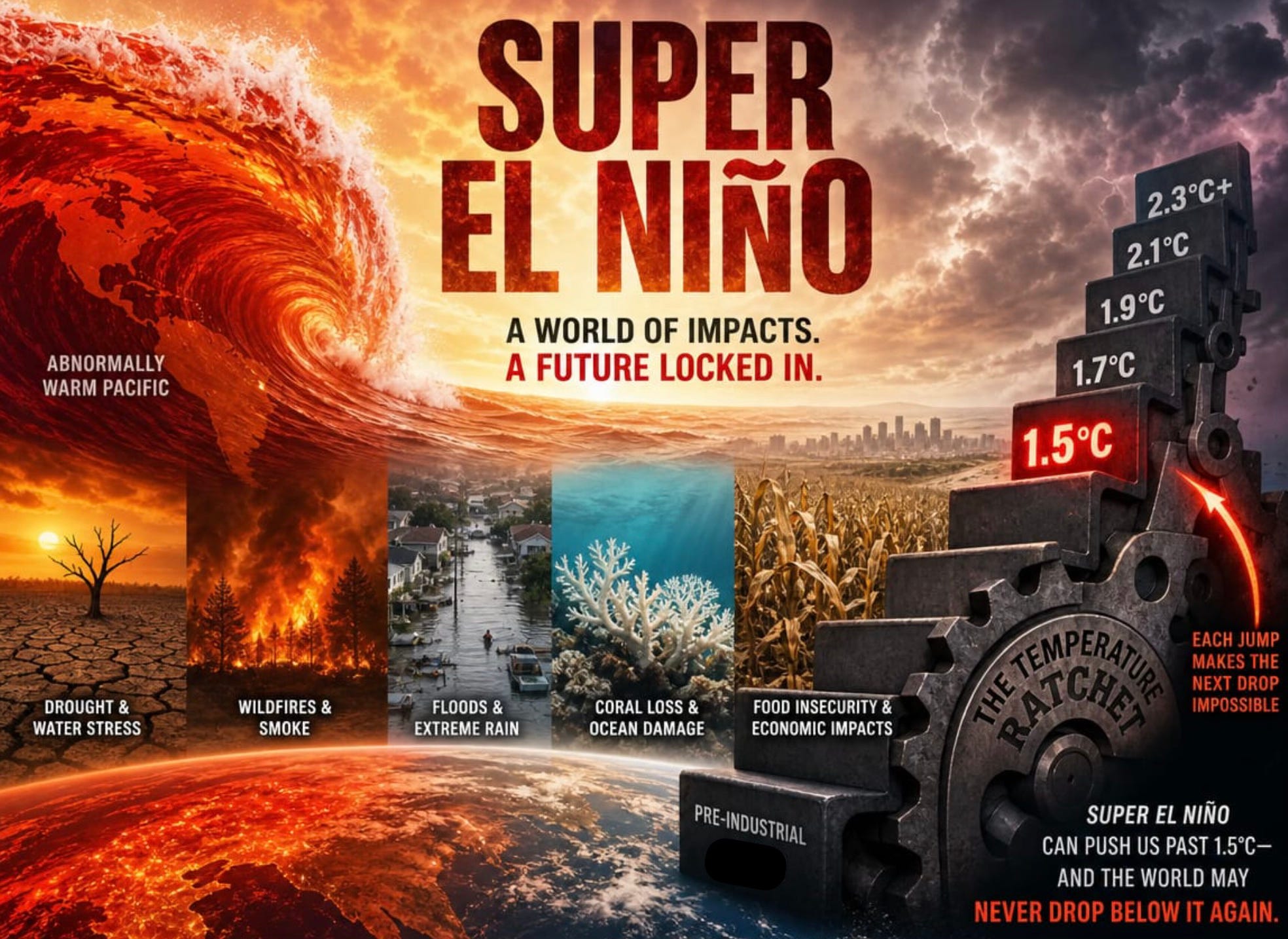
Following a barrage of forecasts and warnings from global meteorological services, the traditional media, as well as social media, has woken up to the looming threat, deploying terms like ‘super’ and even ‘Godzilla’ El Niños as model predictions venture off the charts. The UK Met Office being the latest to issue warmings.1 They are right to do so. If you live in an area heavily influenced by these shifts—such as the Western US, Amazonia, Australasia, South America, the Western Pacific, or sub-Saharan Africa—preparations for the latter half of this year should be made with haste.
However, it is 2027 and beyond that may require our most serious preparations.
How bad are we talking?
The forecasts for the strength of the upcoming El Niño have risen steadily over the last few months, as demonstrated by Professor Eliot Jacobson’s recent model animation on Bluesky.
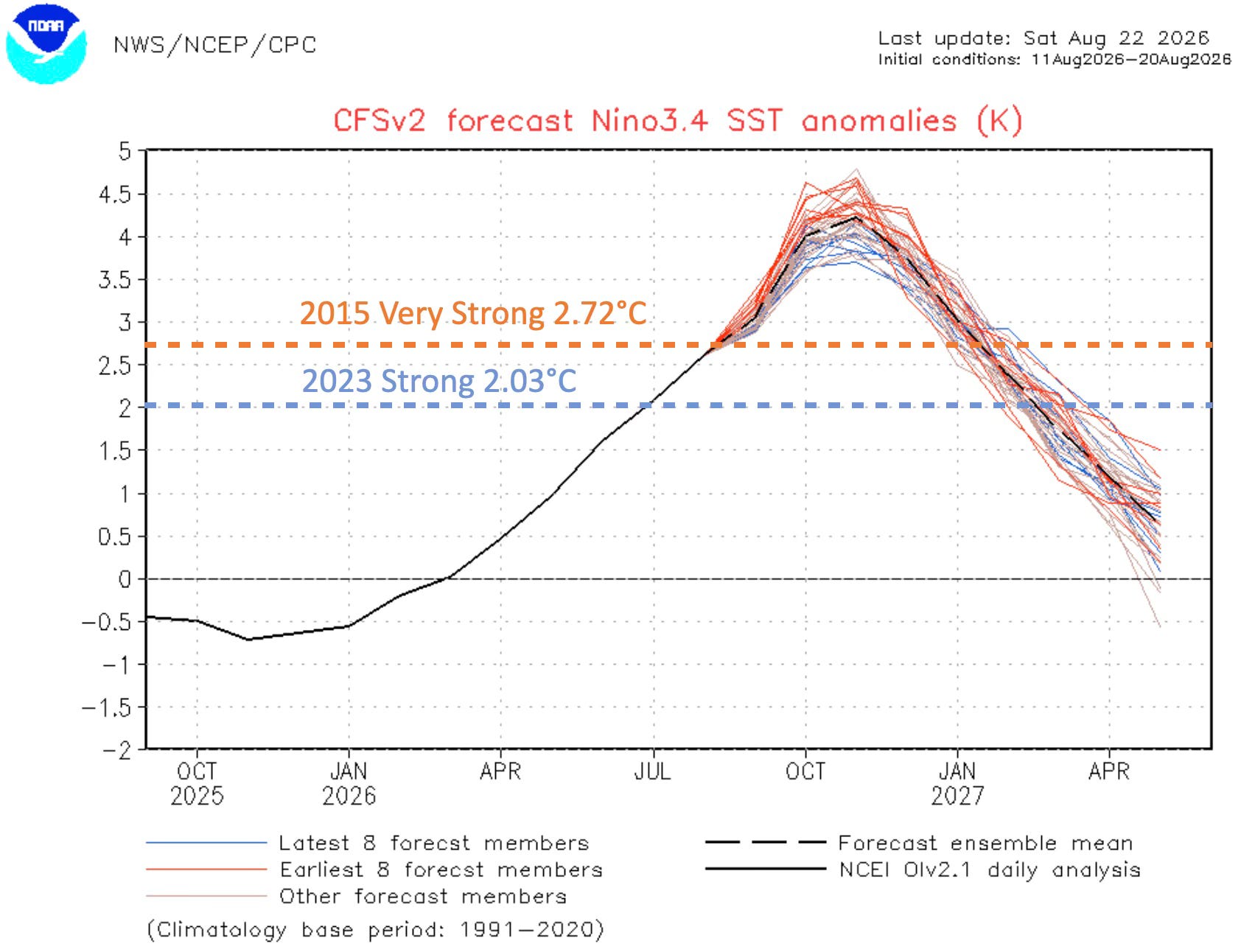
The latest plume plot from the NOAA (Figure 1) is striking. I have overlaid the peaks reached by the 2015/16 (very strong) and 2023/24 (strong) events for comparison. As of August 22nd, the El Niño event is already at the peak temperature of the 2015/16 event NOAA are also currently forecasting a >80% chance of it being ‘very strong’ through to January.2
Beyond the immediate global disruption these events cause, they leave permanent scars. The 2016 event helped to trigger a structural tipping point in Antarctic sea ice, which had been resiliently stable up to that juncture but has since suffered an accelerated decline.3 Meanwhile, the 2023 event drove 2024 to become the first full calendar year to breach 1.5°C of global warming.
Looking further back, an exceptionally strong El Niño in the early 1940s has been definitively linked to the initial unpinning and retreat of both the Thwaites (‘Doomsday’) Glacier and its neighbour, Pine Island Glacier, in West Antarctica.4 Long after the tropical atmosphere cooled down, the glaciers never re-advanced. The anomaly was temporary; the structural destabilisation was permanent. We are still tracking that continuing retreat via satellites today, in fact the final unpinning of the remaining floating ice sheet is imminent.5
Key takeaway: Situate these historical precedents on top of our current baseline of nearly 1.5°C of global warming, and a ‘super’ El Niño in 2026 transitions from an ecological crisis into a literal killer. The implications for global food security and price inflation, especially coming on the back of fertiliser and fuel shortages caused by the US misadventure in the Strait of Hormuz, cannot be underestimated. Mark Roberts has an excellent analysis here.
The short window since the 2023 event might superficially suggest that the Pacific has less accumulated energy available to fuel a monster event so soon. Historically, very strong El Niños are preceded by prolonged neutral or cool La Niña phases, allowing heat to pool in the western Pacific. This time, however, the ocean is primed early. Rare and extreme ‘annular warming patterns’ emerged across the western, northeastern, and southeastern tropical Pacific in spring 2026, whilst subsurface equatorial heat content remains dangerously above average.6
Furthermore, global ocean heat uptake jumped by a staggering 23 zettajoules (ZJ) in 2025 alone. For context, 23 ZJ is roughly 200 times the total annual electricity generation of the entire human race. The 2025 ocean heat uptake represents an eight-fold increase over the 1958–1985 annual mean baseline (~2.9 ZJ).7
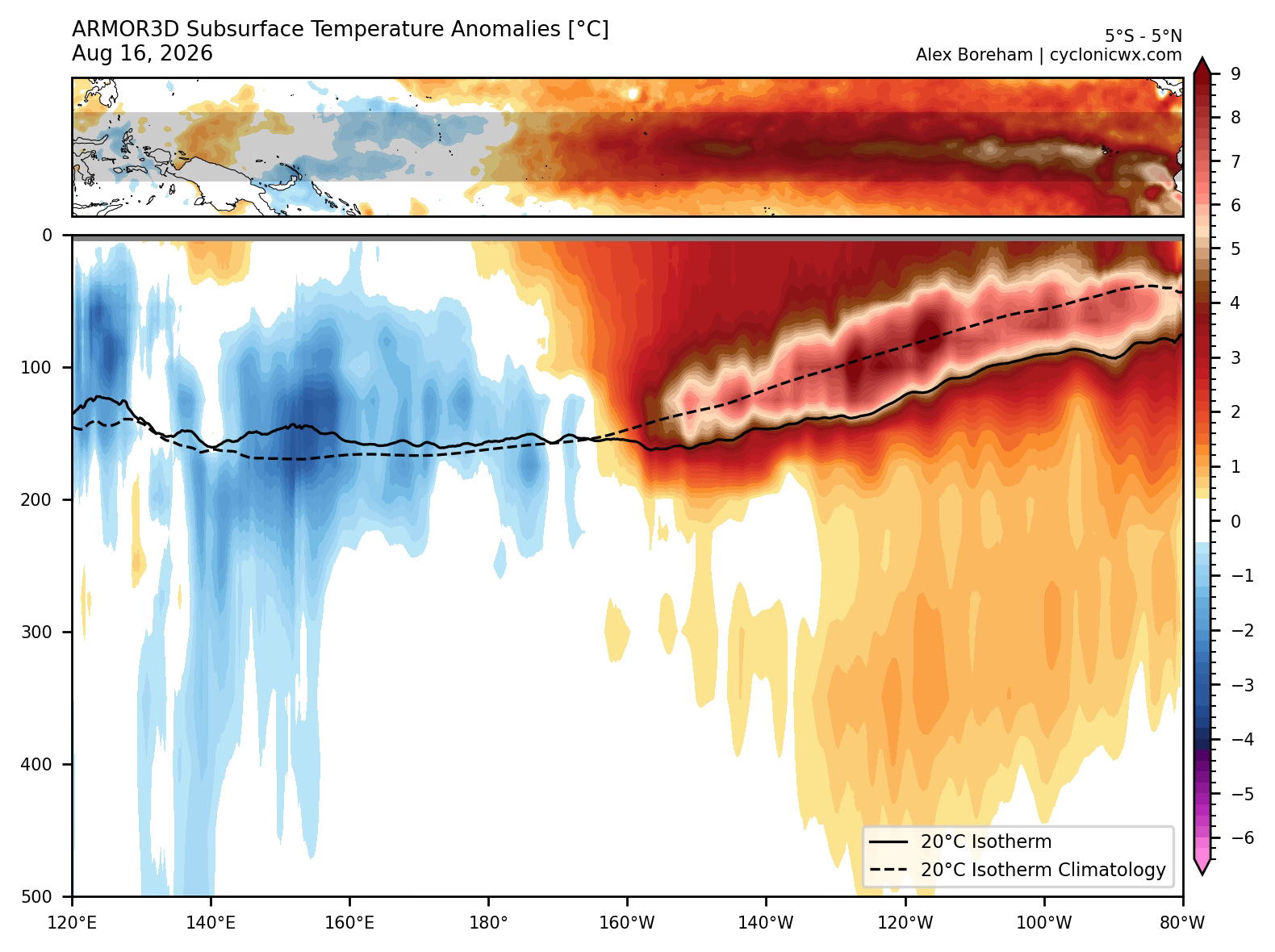
To cap it all off, powerful Kelvin waves continue to charge eastward beneath the equatorial Pacific surface. They are providing a conveyor belt of heat that breaches the surface and releases thermal energy directly into the atmosphere, with subsurface temperature anomalies already exceeding 8°C, less than 100m from the surface (Figure 2).
Immediate Impacts
Numerous commentators have outlined the immediate macroeconomic and humanitarian casualties of a super El Niño event—including a recent summary by The Guardian detailing the risks to the global economy. In a nutshell, we are looking at:
Widespread droughts and heightened wildfire risks
Severe rainfall events and catastrophic flash flooding
Food price shocks (compounded by fertiliser and diesel shortages linked to the ongoing conflicts in the Middle East)
Coral bleaching and death as well as collapsing fisheries catches and regional famine
Extreme heatwaves driving a spike in heat-stress mortality
Surging energy grid demands to power air conditioning
Range expansion of insect-transmitted diseases such as Dengue
Elevated geopolitical tensions and civil conflict
Cats and dogs living together... mass hysteria. (Oh wait, that’s Ghostbusters).
The Warming Ratchet: Phase 1 (2027)
The primary thermodynamic consequence of an El Niño is that it allows the global ocean to exhale. The oceans absorb roughly 90% of the Earth’s Energy Imbalance, so when they release a fraction of that accumulated energy back into the sky, global mean Surface Air Temperatures (SAT) spike.
The magnitude of this atmospheric boost scales with the strength of the ENSO event (Figure 3). By plotting the peak monthly SAT achieved after historical El Niños against the surrounding 18-month mean, the correlation becomes clear: the stronger the oceanic anomaly, the sharper the atmospheric temperature spike.
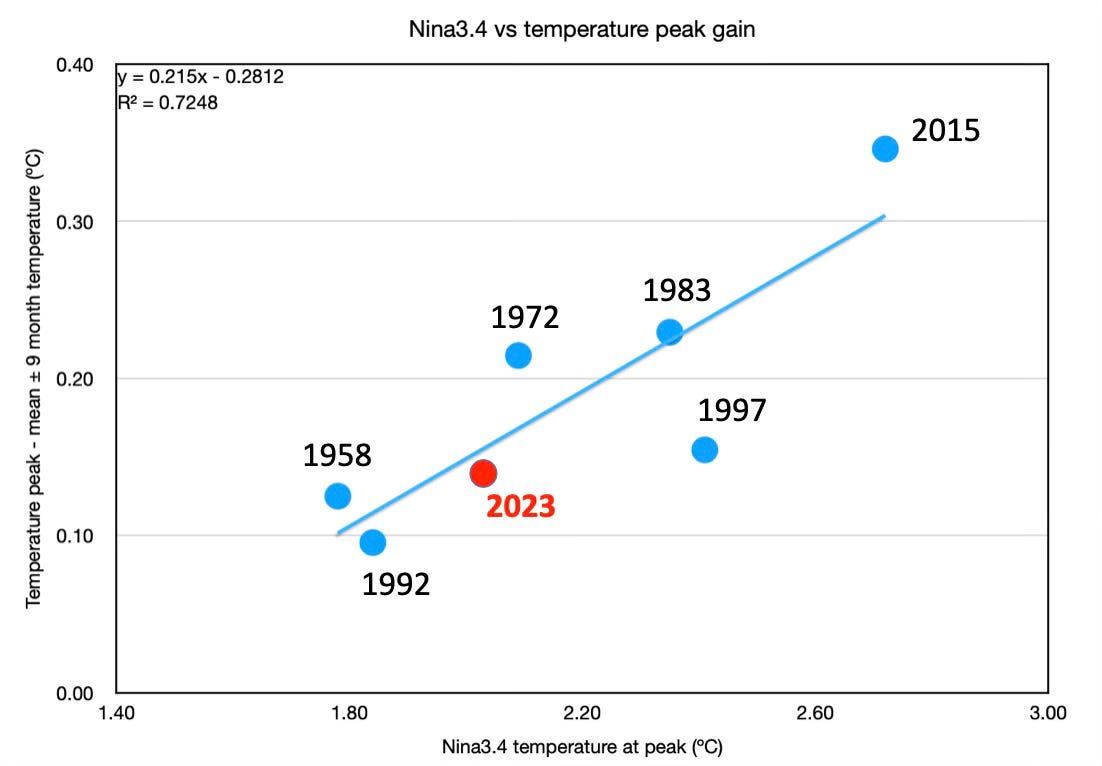
If we take a linear fit of this historical data and project it out across the ECMWF model plumes from figure 1, we get a sobering look at 2027. By adding these projected monthly peaks to our current pre-event baseline (+1.47°C mean global SAT from January 2025 to May 2026), we can establish a conservative look at the upcoming 2027 temperature peak.
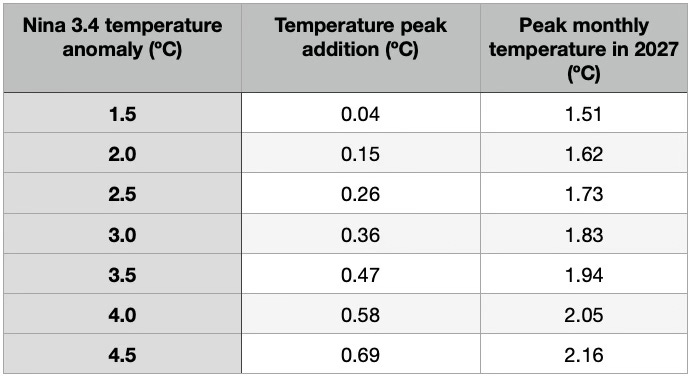
The historical peak monthly anomaly occurred in February 2024 at +1.78°C. The coming event will eclipse this. If the upper-quadrant model projections materialise, 2027 could deliver the first individual month breaching +2.0°C above pre-industrial levels in human history. The full calendar year average for 2027 is highly likely to settle above 1.7°C, shattering 2024’s record by a wide margin.
The Warming Ratchet: Phase 2 (2028–2030)
We have witnessed record-breaking hot years before, but a terrifying systemic pattern has emerged: temperatures no longer drop back down to the pre-existing trend line after the event concludes. Instead, the climate system undergoes a step-change—a warming ratchet that locks in a higher baseline.
Consider the data:
The average global SAT for 2010–2015 was 0.98°C above pre-industrial levels.
The 2016 super El Niño spiked temperatures to 1.14°C.
Crucially, during the subsequent cooling/neutral years (2017–2021), temperatures did not revert to 0.98°C; they ratcheted up to an average baseline of 1.20°C.
We watched this exact mechanism play out again after the 2023 event. The average global temperature from January 2025 to May 2026 sat at 1.47°C—more than a quarter of a degree warmer than the five-year average preceding the 2023 El Niño.
That is not to say that El Niños warm the planet per se, but they release the temperature jumps required to step up global temperatures by the expected 0.2-0.35°C per decade.
The looming danger is that the 2026/27 event will execute the exact same manoeuvre. If it does, 2025 will have been the last year ever* where global average temperatures remained below 1.5°C for a full calendar year. *well for at least 10,000 years anyway!
With 2026 already averaging 1.48°C prior to the onset of the El Niño heat dump, this year should comfortably top 1.5°C by December (aligning with my January prediction of 1.52°C). Interestingly James Hansen is predicting that 2026 will overtake 2024’s record coming in at above 1.6°C for the full calendar year.89 It is most unwise to bet against Jim’s predictions. If he is right, and his logic seems sound, it is a very worrying situation we find ourselves in.
To test his logic very crudely (figure 4) - if we superimpose the August through December 2023 temperature profile onto the 2026 January through July temperatures, then average the year, 2026 would be 1.61°C - indeed just higher than 2024’s 1.60°C.
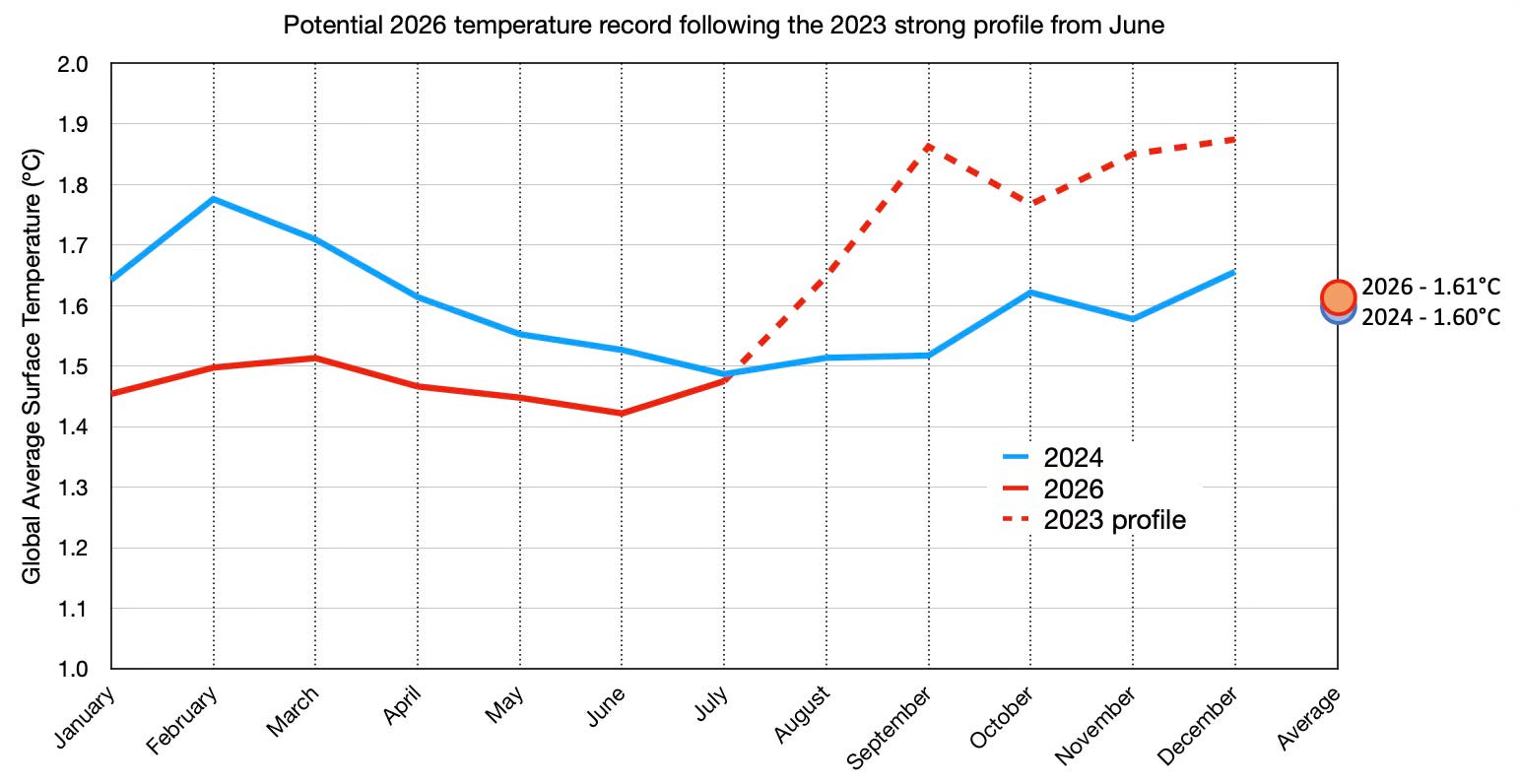
Following that, 2027 will likely soar to between 1.7°C and 1.8°C for the calendar year average. It will certainly be hotter than whatever 2026 delivers, since the peak SAT temperatures lag the ocean temperature extremes. When the system settles in 2028–2030, our new “cool” baseline will likely hover around 1.55°C to 1.7°C—leaving us perfectly positioned so that the subsequent El Niño introduces the first full calendar year at +2.0°C, depending on when it emerges. Permanently passing 2°C during the 2030s now seems unavoidable.
The planetary impacts locked into the backend of this decade will be severe; there is simply too much thermal energy accumulated in the system for any other outcome. This places the planet squarely in the danger zone for a number of the great tipping elements including the West Antarctic and Greenland Ice Sheets, Boreal Permafrost abrupt thawing, Ocean Current disruption and Amazon collapse.
We can only hope that these upcoming systemic shocks finally jolt global leadership and the voting public into treating the crisis with the structural seriousness it demands.
If you found this article interesting or useful, please tick the ❤️ button as it helps the algorithm point more people in this direction and gives us feedback on what subjects are most useful. Thank you!
Guardian article Friday 21st August: https://www.theguardian.com/environment/2026/aug/21/increased-rainfall-and-storms-to-hit-uk-due-to-biggest-el-nino-for-a-century-say-met-office
Official NOAA CPC ENSO Strength Probabilities Issued June 2026, https://www.cpc.ncep.noaa.gov/products/analysis_monitoring/enso/roni/strengths/
Ionita M (2024) Large-scale drivers of the exceptionally low winter Antarctic sea ice extent in 2023. Front. Earth Sci. 12:1333706. doi:10.3389/feart.2024.1333706 https://www.frontiersin.org/journals/earth-science/articles/10.3389/feart.2024.1333706/full
R.W. Clark et al., Synchronous retreat of Thwaites and Pine Island glaciers in response to external forcings in the presatellite era, Proc. Natl. Acad. Sci. U.S.A. 121 (11) e2211711120, https://doi.org/10.1073/pnas.2211711120 (2024).
New Scientist 18th May 2026, The ‘doomsday’ glacier’s giant ice shelf is about to break away, https://www.newscientist.com/article/2526826-the-doomsday-glaciers-giant-ice-shelf-is-about-to-break-away/
Tao Lian, Ruikun Hu, Jie Feng, Ting Liu, Youmin Tang, Dake Chen. Extreme Spring Pacific Annular Warming Elevates the 2026/27 El Niño. Ocean-Land-Atmos Res. 2026;5:0153. DOI:10.34133/olar.0153 https://spj.science.org/doi/10.34133/olar.0153
Pan, Y., Cheng, L., Abraham, J. et al. Ocean Heat Content Sets Another Record in 2025. Adv. Atmos. Sci. (2026). https://doi.org/10.1007/s00376-026-5876-0

James Hansen suggests we are already locked into +2.4°C to +2.7°C. if this is correct, then virtually all major global feedback loops will be triggered.
Hansen also says that we can expect +4.8°C [+/- 1.2°C] with a doubling of CO2. Most likely, we'll pass 2x CO2 by the 2050s, and if we look at CO2e, we'll pass that by 2030.
Add in the rachet effect, and our predicament looks well beyond catastrophic. Here is some context.
At +2.7°C, the geography where over 2.5 Billion people live will become "uninhabitable for parts of the year" and we can expect multiple global bread basket failures. This means 2.5 billion people will have to migrate or die. Where will they go and what will they eat?
At +4.0°C, most of the land between 45N and 45S becomes "uninhabitable for parts of the year". Same question as above - but now we're talking 5.5 billion people having to migrate or die. Oh, and so will all mammals, birds, fish, etc. You get the picture.
Any politician seeking office anywhere, in any country in the world should be making human caused global heating, and the consequences of climate and ecological, agricultural, economic, and social collapse their #1 conversation, policy position, and priority.
If we are to survive, we will have to reorient and remane our civilization, our social contract, our relationship to the earth, to each other, and to all future generations.
Thank you. Another great article. The ratchet effect certainly makes sense considering the current EEI being so high, which hinders the loss of the atmospheric heat introduced by El Nino.